






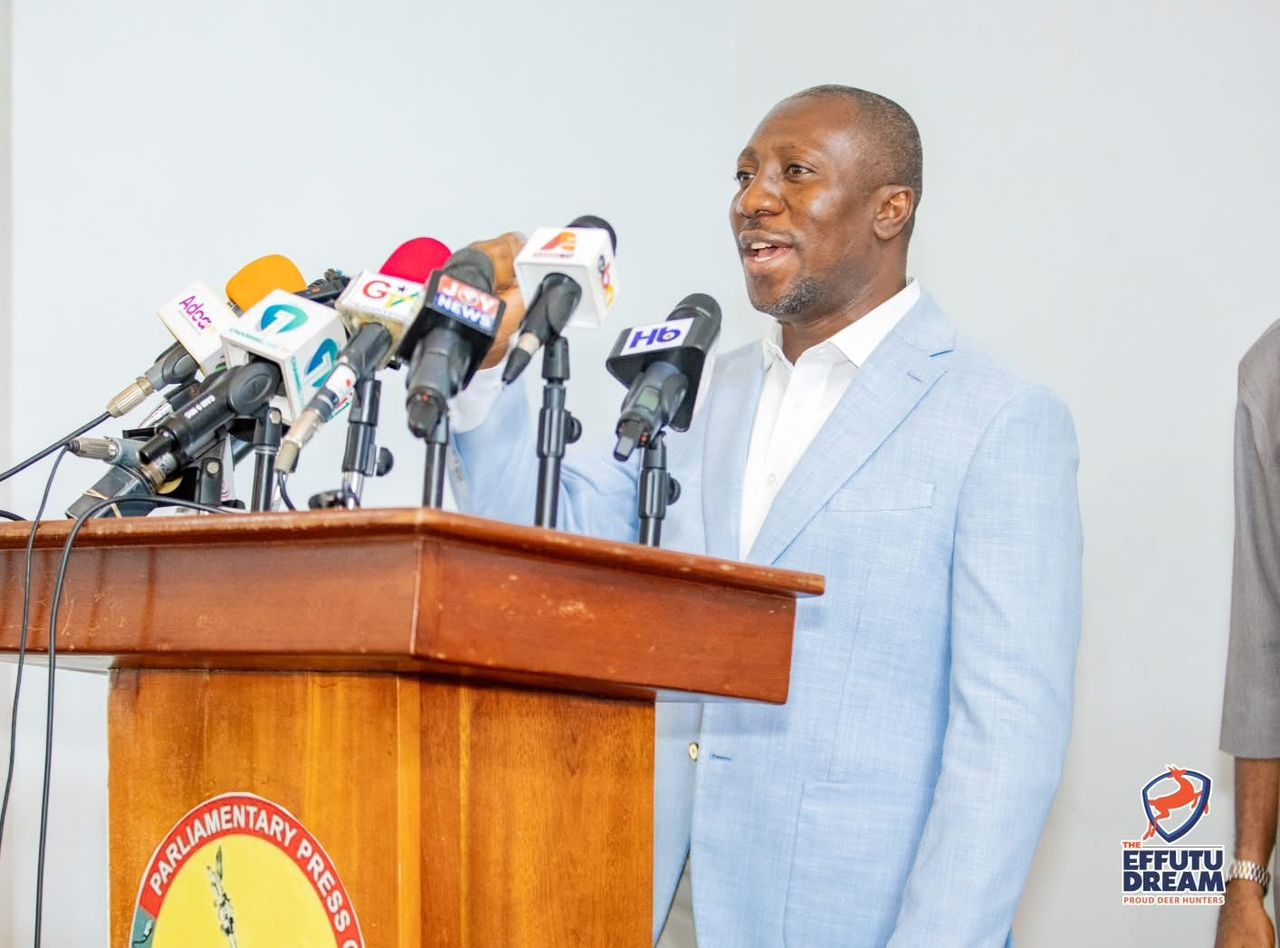
The Minority Leader in Parliament, Alexander Kwamena Afenyo-Markin, has challenged government claims that Ghana’s improving economic indicators are the result of prudent economic management, arguing instead that the gains are largely driven by external factors.
Speaking at the “Holding Government to Account: A Year of Active and Responsible Minority Scrutiny in Ghana’s 9th Parliament,” Mr. Afenyo-Markin acknowledged assertions that the economy is performing well but questioned the basis of those claims.
He contended that the recent economic upswing was not born out of government competence or a deliberate re-engineering of the economy, but rather the outcome of Ghana’s International Monetary Fund (IMF) programme, debt restructuring, and favourable global market conditions.
According to him, debt relief secured under the IMF programme, coupled with reduced government expenditure and rising commodity exports, particularly gold and cocoa have been the main contributors to the positive economic indicators being touted by government.
The Minority Leader further argued that the much-publicised fiscal consolidation was achieved through sharp cuts in spending on critical sectors, rather than through sustainable economic reforms.
He added that the recent appreciation of the cedi was influenced more by the weakening of the US dollar and increased global investment in gold than by domestic policy interventions.
Mr. Afenyo-Markin also noted that the ongoing debt restructuring process, which he said was initiated under the previous New Patriotic Party (NPP) administration, alongside the commodity export boom, accounted for the significant trade surplus recently announced by government.
He disclosed that since May 2023, Ghana has received about US$3 billion under the IMF programme, which has helped unlock further debt relief and external financing.
Mr. Afenyo-Markin emphasized that these developments expose what he described as the government’s hypocrisy in claiming sole credit for the economy’s performance, urging a more honest appraisal of the factors driving the current economic outlook.