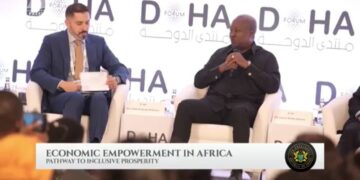






President John Dramani Mahama has stressed the need for African nations to prioritise domestic resource mobilisation in financing education, arguing that global funding support is gradually dwindling.
He made the remarks at the 2025 Doha Forum in Qatar during a high-level panel discussion on Economic Empowerment in Africa: Pathway to Inclusive Prosperity.
President Mahama noted that while international assistance remains valuable, African countries must not overly rely on external sources to sustain and expand their education systems.
According to him, Ghana offers a strong example of what deliberate domestic investment can achieve.
He highlighted the creation of the Ghana Education Trust Fund (GETFund), which receives a dedicated 2.5% value-added tax on goods and services purchased nationwide.
“As a nation, we took a decision that we will all contribute on everything we purchase two and a half percent of value added tax, which goes into what we call the Ghana Education Trust Fund, that fund alone is able to mobilize sufficient revenue to almost hit the 20% mark, and additional budgetary allocation enables us to exceed the 20% global target,” he explained.
President Mahama, who has served as a GAVI Ambassador, cautioned that global funding streams are tightening, making domestic self-reliance even more urgent.
He cited the recent GAVI replenishment, where partners aimed to raise US$11 billion but secured US$9 billion instead.
“The reality is that, that kind of resource is dwindling. The world today does not have the kind of funding, and the mood is not there to fund these kinds of programmes,” he said.
He urged African governments to look at mechanisms locally that enable us to contribute to our own children’s education, emphasizing that sustainable development hinges on countries taking charge of their educational financing models.
He added that although support from development partners such as USAID remains appreciated, long-term progress will depend on Africa’s capacity to mobilise its own resources, build resilient systems and ensure inclusive prosperity anchored on strong educational foundations.