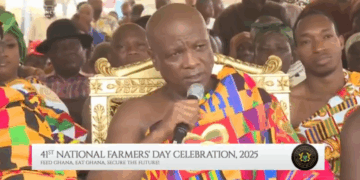







The Agbogbomefia of Asogli State, Togbe Afede XIV, has called for urgent national commitment to revitalising Ghana’s agricultural sector, warning that current declines in key crops and rising food imports threaten the country’s economic future.
Speaking at the 41st National Farmers’ Day celebration held at the Ho Stadium on Friday, December 5, Togbe Afede XIV said the event must serve as both a recognition of farmers’ sacrifices and an inspiration for renewed dedication from government, citizens and the agricultural workforce.
Togbe Afede XIV acknowledged the many challenges confronting the sector but stressed the need for collaborative action
“Through this celebration, we want to inspire our farmers to do more. Of course, government must also commit to doing more, while we as citizens commit to eating Ghana so we can grow Ghana and secure the future of the motherland,” he said.
He expressed concern about declining output in several major crops, particularly cocoa, which has seen production fall sharply in recent years.
Recounting his visit to Hohoe on November 23 to promote investment in a new cocoa processing factory, he said the experience revealed the severity of the situation.
“For a country that has produced more than a million tonnes of cocoa in a particular year to now be struggling to do half a million is not a good commentary,” he noted, adding that value addition can only be feasible if production volumes recover.
He also highlighted worrying declines in cashew and coffee, stressing that these trends indicate the need for intensified efforts across the sector.
Despite agriculture employing about 44 percent of Ghana’s population, far above the global average of 27 percent and Europe’s 4 percent, Togbe Afede XIV lamented that the country still relies heavily on imported food.
“Countries with only 4 percent of their population in agriculture are able to feed themselves. Why not we with 44 percent? It means we have a lot of work to do,” he said.
Ghana’s annual food import bill, currently estimated between US$3.5 billion and US$4.5 billion, he said, underscores the urgent need to boost domestic production.
He urged the nation to make better use of idle labour and uncultivated arable lands.
He called on farmers, policymakers and citizens to work collectively to deepen local production, enhance value addition, and ensure agricultural sustainability.