



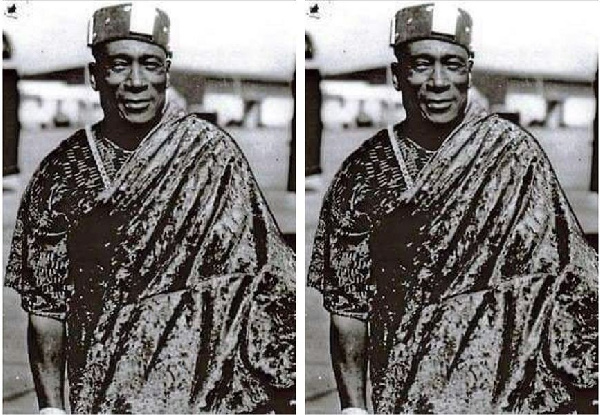
Today in History, exactly 72 years ago, Nii Kwabena Bonne II organized a boycott of all European goods in response to their high prices which was having a toll on the living conditions of people in the Gold Coast.

Nii Kwabena Bonnie II also known as Kwamla Theodore Taylor was a Gold Coast (Ghanaian) radical nationalist, traditional ruler
In 1948, Gold Coast was a British colony in West Africa; the people had no say in political or economic life.
During World War II, large trading companies increased prices on scarce items to maintain profits.
After the war ended, the high prices and shortages continued to persist.
Road to the Boycott
In 1947, Chief Nii Kwabena Bonne formed the Anti-Inflation Campaign Committee in Accra
in response to the inflated retail prices on goods imported in Ghana by European firms.
That same year in December, Nii Kwabena Bonne sent a letter to the Chamber of
Commerce in Accra outlining the position of the Anti-Inflation Campaign Committee: the
prices on imported European goods were too high, which in turn made the cost of living nearly unmanageable.
Nii Kwabena Bonne II and the Anti-Inflation Campaign Committee demanded that the
European firms lower the prices of goods, especially cotton textile items.
The United Africa Company (UAC)
Kwabena Bonne directed this letter to the United Africa Company (UAC), a subsidiary of the Anglo-Dutch multinational Unilever, in particular.
Nii Bonne II also included a date by which time a letter of response was to be received: 24 January 1948.
If the European firms failed to send a response by that day, the Ghanaians would strike.
During the time the Anti-Inflation Campaign Committee was waiting for a response, Nii
Kwabena Bonne toured the country to explain his plan to boycott European goods to the chiefs and people of other towns and cities throughout Ghana.
Nii Bonne’s plan received widespread support.
The chiefs of Manya Krobo, Suhum, Akim Oda, Cape Coast, Sekondi, Tarkwa, and Axim either gave their support or pledged to join the boycott.
By the day the ultimatum was to expire, there still had been no response by the Chamber of Commerce or the UAC.
The UAC had not considered Nii Kwabena Bonne II ‘s letter or the matter to be serious, as the company did not believe that the Africans could unite.
The company believed that the Africans did not understand the value of money well enough to carry out a cohesive plan successfully.
Nii Kwabena Bonne II ’s letter had never even been forwarded to the UAC head office in London.
The Boycott
As was the plan, the boycott began on 26 January 1948. The products boycotted by the Ghanaians included cotton prints, tinned meat, and flour biscuits.
Although the main items boycotted were European imported goods, goods from other
foreign-owned stores, such as Indian and Lebanese products, were also boycotted.
The boycotters were guided by the slogan “We cannot buy; your prices are too high.
If you don’t cut down your prices then close down your stores; and take away your goods to your own country.”
The economic boycott was very successful as it resulted in the closure of many shops.
On 11 February 1948, the Colonial government, which had originally declared that it would
not interfere, as it was a trade dispute between the people and the foreign traders, was
forced to arrange a series of meetings between the Chamber of Commerce in Accra and the
Anti-Inflation Campaign Committee as well as the other chiefs who had joined in the boycott.
Tensions flared during the time the meetings were held, and on 17 February a crowd
demonstrated in front of the magistrate’s court during the trial of a chief charged with imposing fines on non-boycotters.
The Agreement
On 20 February, an agreement was reached as some of the foreign firms assented to reducing their overall profit margin from 75 to 50 per cent.
The Government announced over the radio that, as a result of the negotiations between the
Chamber of Commerce and the Anti-Inflation Campaign Committee, prices on some
imported goods would be reduced and the boycott would end on 28 February.
Although many boycotters, and other non-boycotting Ghanaians, rejoiced over this feat,
they were disappointed when the prices were not reduced as much as they had anticipated.
The boycotters and other Ghanaians had taken the 75 to 50 per cent reduction as meaning
a 50 percent decrease in prices, but in fact it had referred to overall profit margins.
Therefore, in reality the prices on imported goods changed very little, and as a result the change in the cost of living was negligible.
This campaign to boycott European goods and lower the cost of living in Ghana became part of the preparation for the 1949-51 campaign for independence.
On the last day of the boycott, African ex-servicemen began a march from Accra to the
British governor to present him with a petition, but were stopped by police.
This led to rioting by Ghanaians in response to police brutality, which Nkrumah of the
United Gold Coast Convention used to demonstrate the readiness of Ghanaians for independence.
Nkrumah and members of the Convention People’s Party, which Nkrumah formed, then began to campaign for Ghana’s independence from British rule.
Bibliography
Amamoo, Joseph G. The New Ghana; the Birth of a Nation. London: Pan, 1958. Print.
Austin, Dennis. “The Working Committee of the
United Gold Coast Convention.” Journal of African
History. 2nd ed. Vol. 2. Cambridge: Cambridge UP., n.d. 273-97. Print.
Bianca Murillo. ““The Devil We Know”: Gold Coast
Consumers, Local Employees, and the United Africa Company, 1940–1960.”
Enterprise & Society 12.2 (2011): 317-355. Project MUSE. Web. 14 Oct. 2012.
Source: ghanaianmuseum