



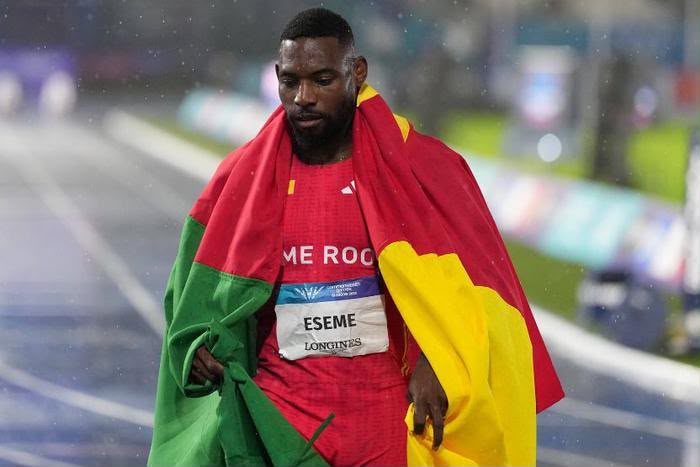
Emmanuel Eseme powered through the rain at Scotstoun Stadium to win gold in the men’s 100m at the 2026 Glasgow Commonwealth Games, delivering Cameroon its first ever medal in the event and one of the most talked-about moments of the Games so far.
The 100m final is widely regarded as the marquee event of any major athletics championship, since it crowns the fastest man in the field over the shortest, most explosive distance in the sport. Winning it, especially in front of a global television audience, turns an athlete into a household name almost overnight.
Eseme had already served notice of his form by qualifying fastest for the final in a lifetime best of 9.89 seconds.
In the final itself, run on a wet track, he shaved off a further six hundredths of a second to stop the clock at 9.83 seconds (1.3m/s). It was a Games record that pushed aside a mark that had stood since Ato Boldon won in Kuala Lumpur in 1998, a new Cameroon national record, and a time that puts him third on the African all-time list and third-fastest in the world this season.
The 32-year-old held off a strong challenge from Australia’s Lachlan Kennedy and Nigeria’s Kayinsola Ajayi to take the title.
The victory carries extra weight for Cameroon, a country that had never previously won a medal in the men’s 100m at the Commonwealth Games.
It also ends a longer wait for the nation on the track generally, as Cameroon’s last Commonwealth Games athletics medal came almost two decades ago, when Delphine Atangana took bronze in the women’s 100m at Melbourne 2006.
It is Eseme’s second appearance at the Commonwealth Games. Four years ago in Birmingham, he reached the finals of both the 100m and 200m but left without a medal.
Since then, he has built a decorated career, winning the 2024 African Games 100m title, taking the 2026 African Championships crown, and setting national records across the 60m, 100m and 200m.
Eseme said he had gone into the final with a clear plan, aware that his acceleration out of the blocks is not always his strongest asset compared with his rivals.
“It’s like the hard work has paid off,” Eseme said. “I worked so hard for this and to be able to reap from all the work I’m doing, I just say thanks to god and my team and I’m very happy.
After the semi-final, I just said to myself, ‘You may not be the best starter. They may let you go in the first 50 metres, but just keep it, don’t rush anything and just execute your race’. Somehow at the end I know I’m going to catch them.”
The plan worked perfectly. Eseme was trailing for much of the race before surging past Kennedy and Ajayi in the closing metres to snatch gold on the line, unfazed by the rain that had soaked the track throughout the session.
He has previously spoken of drawing inspiration from other African sprinters who have broken into the world’s elite in recent years, among them South Africa’s Akani Simbine and Botswana’s Olympic champion Letsile Tebogo. He said their success has helped convince a new generation of African athletes to believe they can compete with, and beat, anyone in the world.
Eseme’s win was one of three Games records broken during the first two days of competition at Scotstoun Stadium, underlining the high standard of racing at this year’s championships.
By: Prince Obiba Ayim Brown – Glasgow, Scotland