




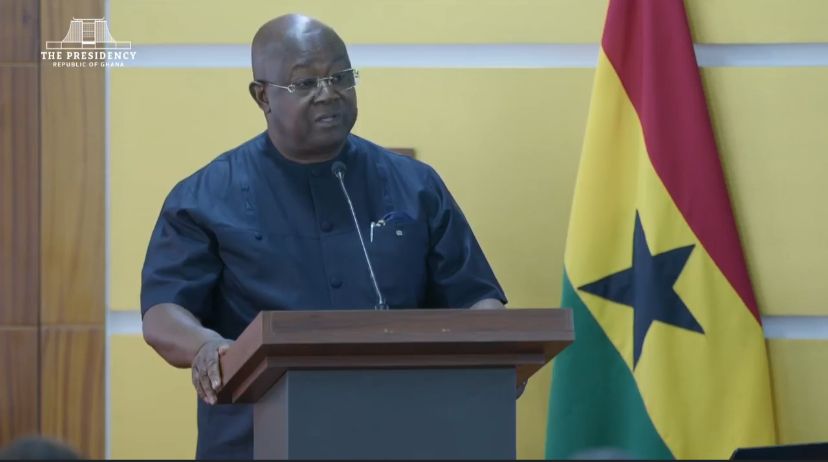
The Lead investigator Captain Paul Forjoe, who spearheaded the probe into the August 6 Ghana Air Force helicopter crash, has outlined the extensive methodology used to determine the causes of the tragic accident that claimed the lives of eight high-ranking government officials and military officers.
During the official presentation of findings at the Presidency on Tuesday, November 11, Captain Forjoe explained that the Preliminary Investigation Team was dispatched on the very day of the crash to secure the site and preserve key evidence.
“The Preliminary Investigation Team was dispatched on the same day of the accident to secure the site and protect perishable evidence such as memories, physical wreckage, and personal effects,” Captain Fordjour said, describing the first critical steps taken by the investigation team.
The crash involved a Harbin Z9- EH military helicopter (tail number GHF 631) operated by the Ghana Air Force, which departed Accra at about 9:12 a.m. bound for Obuasi in the Ashanti Region.
The aircraft was on a mission related to anti-illegal mining operations when it lost radar contact near Adansi Akrofuom District.
All eight passengers and crew on board perished in the crash. The victims included: Dr. Edward Omane Boamah, Minister for Defence, Ibrahim Murtala Muhammed, Minister for Environment, Science and Technology, Muniru Mohammed Limuna, Acting Deputy National Security Coordinator, Samuel Sarpong, NDC Vice-Chair, Samuel Aboagye, former parliamentary candidate, Squadron Leader Peter Bafemi Anala, Flying Officer Manaen Twum Ampadu, Sergeant Ernest Addo Mensah
According to Captain Forjoe, the investigation board comprised officials from multiple agencies, including the National Security, Ghana Armed Forces, Aircraft Accident and Incident Investigation and Prevention Bureau, National Intelligence Bureau, and U.S. Air Force advisors.
The team conducted a comprehensive analysis of all available evidence, including flight logs, maintenance records, and crew qualifications.
The flight data recorder and cockpit voice recorder, commonly known as the black box, were sent to the AVIC Flight Decoding Centre in Xi’an, China, between September 12 and 22, 2025, for data extraction and analysis due to the helicopter’s Chinese make.
Beyond technical analysis, investigators also assessed human factors and operational procedures. This involved reviewing the medical and psychological records of the flight crew, conducting interviews with pilots, engineers, supervisors, and family members, and evaluating weather data from the Ghana Meteorological Agency alongside Terminal Aerodrome Forecasts (TAFs) and eyewitness accounts.
Captain Forjoe said the inquiry further examined Ghana Air Force operational policies, including flight orders, oversight mechanisms, and risk management systems, to better understand the organisational context of the mission.
The air tasking order for the day, he noted, covered the transport of the Minister of Defence and his delegation from Accra to Obuasi and back.
“Using flight recorder data, radar tracks, eyewitness accounts, and analysis of similar accidents, we reconstructed the flight path to understand what led to this tragedy,” Captain Forjoe stated, stressing that no detail was overlooked in the effort to uncover the truth behind the fatal crash.