



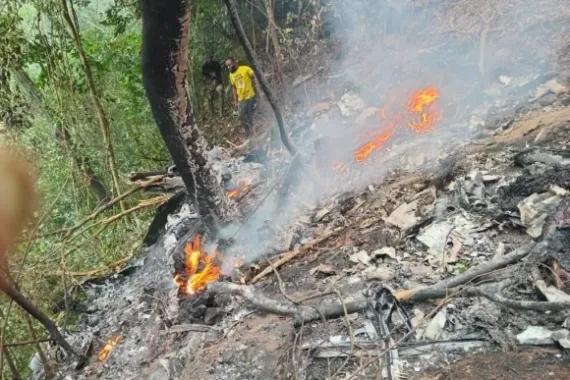
The committee established to investigate the August 6, 2025 Ghana Air Force helicopter crash has revealed that the fatal incident was caused by a sudden downdraft that forced the aircraft to lose altitude moments before impact.
Presenting the findings at the Presidency on Tuesday, November 11, 2025, the Lead Investigator and former Deputy Chief Executive Officer of Ghana Airways, Captain Paul Forjoe, said the Harbin Z-9 helicopter, which was en route to Brofoyedu in the Adansi Akrofuom District of the Ashanti Region, was airworthy at the time of the accident but encountered rapidly deteriorating weather conditions.
According to Captain Forjoe, the flight, which departed Accra under visual flight rules (VFR), was uneventful until it approached Brofoyedu, about 90 miles from Accra and 10 miles from Obuasi. Visibility then deteriorated sharply due to mist and low clouds.
“At 9:56 a.m., the crew entered instrument meteorological conditions (IMC), meaning they were flying in clouds, and transitioned from visual flight rules to instrument flight rules (IFR), relying solely on the aircraft’s instruments,” he explained.
The crew then initiated a climb to cross the rising terrain but, seconds before impact, reported sighting the high ground below.
“Suddenly thereafter, the helicopter, which had maintained power and pitch, lost height and struck the ridgeline about six and a half miles from its destination,” Captain Forjoe said.
The impact occurred at approximately 9:58 a.m. at an altitude of 1,370 feet above sea level.
He noted that the helicopter was airworthy but lacked certain safety enhancements, including a Terrain Awareness Warning System (TAWS), which could have alerted the crew to the rising terrain.
“Such a system provides predictive alerts, giving pilots a clearer picture of surrounding terrain and helping them make safer judgments,” he added.
The investigation also cited adverse weather, limited visibility, rugged terrain, and the absence of ground-based navigational aids as contributing factors.
Captain Forjoe, however, commended the emergency response teams, describing their actions as remarkably timely.
He said rescuers reached the crash site within two hours despite the difficult terrain, steep slopes, and heavy rain.
“The investigation determined that the accident was caused by a sudden loss of altitude due to a downdraft — a rapid downward air current — consistent with changing environmental conditions over high terrain,” he added.